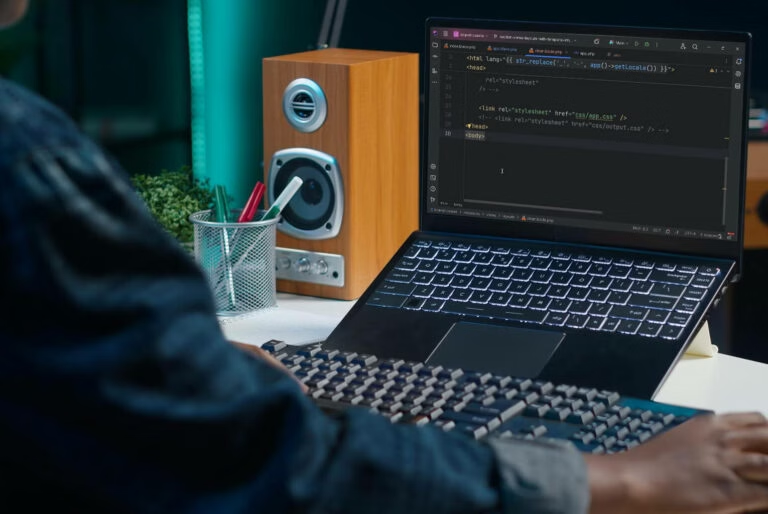
Custom Web Design in 2026 is a combination of three key elements. Conversion Rate Optimization. Accessibility Compliance with WCAG 2.2. Mobile First Responsive Layout. Professional custom web design will convert your Brand Identity into Measurable Business Outcomes such as Lower Bounce Rates, Higher Engagement, and More Leads.
Custom Web Design gives your business an advantage over competitors. Your custom-designed website is the best employee you will ever have. It never takes a break; it always represents your company to each new customer and determines whether or not a potential customer becomes an actual customer in just seconds. With so many template-style websites that appear very similar, a custom-designed website can be the difference maker for your company.
In this article, we are going to cover what you should consider when creating a custom website for your company in 2026, starting with how to think strategically about design and ending with the practical considerations of cost, timeline, and who to work with as a partner.
What Makes Custom Web Design Different from Templates
Website templates such as those used by Squarespace, Wix, and premium WordPress themes allow for fast entry onto the World Wide Web. The same templates can be appropriate for a personal blog or for a small, local business. They are, however, accompanied by compromises that become more pronounced over time.
You have no choice in regard to how you present your brand story in order to fit your brand story within the pre-defined layout of your templates. In addition to forcing your brand story into a generic navigation pattern, template sites also have the added disadvantage of carrying with them excessive amounts of code (dozens of unnecessary features), which will negatively impact the speed of every page load.
Conversely, custom web design begins with the reverse approach. Rather than determining what template best fits your business and then trying to fit your business into the template, the first consideration when developing a custom website is “what does my target audience require and how will I develop exactly that?”
As a result, each individual component on your web page was placed there based on research and strategy regarding your target audience.
In terms of performance, the difference is measurable. Custom-built websites consistently outperform template sites in terms of Core Web Vitals, load time, and conversion rates. Since each line of code on a custom-built website serves a purpose, there is no waste to impede the speed of the site.
It should be noted, however, that “custom” does not necessarily mean that all aspects of your website will be developed from scratch. A skilled web development firm working with WordPress can develop a completely customized theme utilizing a robust Content Management System (CMS), thereby providing the flexibility to edit your web site through WordPress while limiting the drawbacks of an off-the-shelf theme.
The UX-First Approach: Designing for Conversions, Not Just Aesthetics
A beautiful design that doesn’t convert is simply expensive decor.
The most successful websites in 2026 will be built UX-first; the goal of UX-first is to make sure user experience research is driving every design choice made before a single pixel is laid down.
This begins by identifying your target audience. Who will be visiting your website? What will they want to do at your website? What questions will they have? What will likely cause them to hesitate or object to taking an action? Your answers to those questions will define everything, including your site’s navigation structure, page layout, and even the words written on buttons.
The information architecture — the organization and structure of the content — is where the majority of the real conversion work occurs. An effectively organized site allows visitors to navigate through a logical process: being aware of their problem, being educated on the solution, having the evidence that the solution works, and having a direct way to take action. This is NOT manipulating people. This is eliminating friction and providing the easiest route possible for people who need your product/service to find and use it.
Using wireframes and prototypes, you can test these structural design choices prior to spending money on developing the visual design. A wireframe is essentially a blueprint. It illustrates exactly where each component will go and how each page connects. Without the distractions of color and images, you can test wireframes with actual users and identify any issues with the navigation of the site as well as any gaps in the content. These types of issues identified using wireframes can be corrected relatively inexpensively and quickly.
Once the structure has been proven out visually (colors, typography, imagery, and spacing) will begin. All of these items are designed to support the conversion strategy and provide visual hierarchy to draw attention to the appropriate components and build the trust signals necessary for visitors to feel comfortable engaging.
Deutrix follows the same sequential order of design. Our design process begins with discovery/research, followed by wireframing/testing, and lastly visual design. It may take just a little bit longer than designing mock-ups first, but the outcome clearly speaks in terms of conversion rates.
Mobile-First and Responsive Design in 2026
More than 60 percent of global web traffic comes from mobile devices. More than 75 percent of web traffic in many industries, including restaurants, local service, and retail, comes from mobile devices. Google has been using mobile-first indexing for years, which means the mobile version of your website will determine your search ranking.
Designing a website with a mobile-first design approach is not the same as creating a responsive design. A responsive design allows a desktop website to be adaptable to smaller screens. Designing a website with a mobile-first design allows you to design the smallest screen first and progressively enhance larger screens. The two approaches are different, as they require you to prioritize the content on each page. When working with a 375-pixel-wide mobile device screen, you cannot display all content at one time. The mobile-first design approach requires you to identify what is the most important item on the page. What can an individual accomplish on a webpage with one thumb while waiting in line? Typically, the clarity of purpose gained by identifying what the most important items are on a webpage will also improve the user experience of your desktop version, due to the elimination of the clutter that results when designers have endless room to add content.
The key design principles of mobile-first design include:
- Touch-friendly tap targets (minimum of 44 x 44 pixels)
- Thumb zone aware navigation
- Performance budgets that consider slower mobile network speeds
- Readable font sizes (minimum of 16 px body font)
- Simplified forms that do not request additional information.
To learn more about why mobile-first design is valuable and how to create it, visit our in-depth guide to mobile-first design.
Accessibility and WCAG 2.2 Compliance
Accessibility to the web is no longer discretionary but a necessity and increasingly a mandatory legal condition. The Web Content Accessibility Guidelines (WCAG) 2.2 provide a definition of what constitutes a website accessible to users with disabilities, whether by reason of a visual, auditory, motor, or cognitive impairment.
In practice, this includes the need to ensure there is adequate color contrast between text and background, make all functions available through keyboard-only input, provide descriptive “alt” text for images to allow screen reader software to read the image, design forms with clear labeling and useful error messages, and caption videos. Many companies are unaware that improving accessibility will improve the usability of a company’s website for all users. Clearly labeled navigation will help both individuals with cognitive disabilities and busy working professionals. Higher contrast between text and background will improve readability for individuals with low vision and for anyone viewing their phone in direct sunlight. Users with physical disabilities and power users who prefer to use keyboard shortcuts will appreciate that all functions can be accessed through keyboard-only input.
Additionally, improving accessibility will improve SEO. Images can’t be seen by search engines; therefore, search engines rely on alt text as much as screen readers. A clearly defined hierarchy of headings will assist both assistive technologies and search engine crawlers in understanding the organization and content of your web pages. Clean code, which is the result of building an accessible web application, will perform better than non-clean code on every performance metric. Building accessibility into a custom website at its inception is essentially free. Retrofitting accessibility to an inaccessible website after launch may require $1,000s and may still fail to identify issues that would have been identified during development had accessibility been given priority.
The Web Design Process: From Brief to Launch
Understanding the steps involved in the process of developing a custom web design can help clients determine which agencies may be the best fit for them. The following is an overview of the typical steps involved in completing a custom web design project.
Discovery and Research (1-2 Weeks): During this phase of the project, the foundation of the project will be developed. This involves learning about your company, the people who will use your site (your target audience), your competition, and your goals. The deliverables associated with the discovery phase will be the project brief, the personas of your audience, and a competitive analysis. More questions should be asked during the discovery phase than at any time in the remainder of the project.
Strategy and Information Architecture (1-2 Weeks): Following the discovery phase, the next step is to develop the overall plan and the way your site will be organized. A sitemap will be created to illustrate the organization of all of your pages, as well as the relationships between those pages. User flow diagrams will also be created to illustrate how users will navigate your site to reach key areas. A content strategy will be developed to identify what each page must do.
Wireframing and Prototyping (1-2 Weeks): Low-fidelity wireframes will then be developed to illustrate the basic layout and structure of your site. An interactive prototype will be created to allow you to click through the site and see how users will navigate it. It is easier and less expensive to correct structural errors during this phase of the project.
Visual Design (2-3 Weeks): Once the overall plan has been developed and the site’s basic layout and structure have been determined, the UI designer will apply your brand identity to the approved wireframes. This includes developing the color scheme, typography, imagery style, button designs, and all of the visual elements that define your site‘s personality. There are usually two to three rounds of revisions included.
Development (3-8 Weeks): Next, the developers will take the approved designs and build them into a fully functional website. This includes setting up the Content Management System (CMS) (e.g. WordPress, Laravel, etc.), implementing the responsiveness of your site across all screen sizes, building out the functionality of your site (e.g. forms, search, e-commerce, etc.), and optimizing the performance of your site.
Content Population (1-2 Weeks): After the development of the site, the content will need to be populated into the site. This is frequently the largest bottleneck in a project. Many projects experience a delay while awaiting the content needed to complete the site. It is beneficial to start preparing your content during the design phase so that it does not hold up the completion of the project.
Testing and Quality Assurance (1-2 Weeks): Testing will occur after the site has been populated with content. Cross-browser testing, mobile testing, accessibility testing, performance testing, form testing, and repairing any defects discovered during testing will all occur. This phase is critical to ensuring that the site functions properly. Skipping this phase is not recommended.
Launch (1 Week): DNS migration, SSL certificate setup, redirects to new URLs, analytics installation, and close monitoring for any issues that arise immediately after the site goes live. In addition to the immediate post-launch period, it is beneficial to remain engaged with your agency for at least 2-4 weeks to ensure that any issues that become apparent with actual traffic are resolved.
The total time required to develop a majority of business sites is generally between 8 and 16 weeks from the start of the project until the site launches. For more detailed guidelines regarding the expected length of time for different types of web development projects, please refer to our guide on website development timelines.
How Much Does Custom Web Design Cost in 2026?
The first thing every business owner wants to know about their website is how much it will cost. Honestly, this is something that varies based on what you’re looking to build. That being said, below are some rough estimates for what websites might cost in 2026.
Brochure-style websites (i.e., basic sites with 5-10 pages, no shopping cart) that include a basic Content Management System (CMS) are usually priced anywhere between $3000 and $8000. More complicated business websites that have custom features, 10-25 pages, and/or multiple integrations will likely fall into the range of $8000 to $20,000. For example, if you want an e-commerce store using WooCommerce, these sites generally start out around $10,000. However, the price of a WooCommerce site can quickly escalate to over $35,000 as you add more products and create custom checkout flows. If you want to build a custom web application using Laravel or another framework, these sites can start around $20,000 and grow in price from there.
It’s worth noting that the prices listed above represent agencies that follow the entire process I mentioned earlier. There are many other ways to get a website, including cheaper options. However, these options usually skip the discovery phase, skip the testing phase, and provide a site that may look good, but does not perform well in terms of the metrics that matter most to your business.
In almost all cases, the cheapest option ends up costing more in the long run. An example of this would be a $2000 template-based site that has to be totally redesigned two years after it was initially created due to its inability to meet the increasing demands of your business. In contrast, a custom website that costs $10,000 but has been able to keep up with your company’s growth for 5 years or more will ultimately end up costing less.
To learn more about what factors contribute to lower/higher costs when it comes to building a custom website, please visit our website pricing guide.
How to Choose the Right Web Design Agency
Choose an agency wisely. Your agency will determine your digital presence for years to come. Here is what to look for, and what not to look at.
Case studies. A portfolio may be pretty pictures, but case studies show results. Traffic growth. Conversion improvement. Performance gains. Agencies that measure success are thinking about your success — not just their designs.
Agency process. How does the agency work? If discovery and research are not mentioned in the first conversation, that is a red flag. Agencies that jump straight to design are guessing solutions, not researching them.
Who actually works on your project? Some agencies sell with senior staff, and deliver with junior staff. Some agencies outsource development to offshore teams without telling you. While neither is necessarily disqualifying, you deserve full transparency about who will do the work.
Technical expertise. Can they explain their technology recommendations in terms you understand? Do they recommend technologies based upon your needs, or do they recommend one stack for every client regardless of the situation?
Ongoing support. What happens after your site goes live? The best agencies offer ongoing maintenance and support because they know that a website is never truly “done” — it needs regular updates, security monitoring, performance tuning, and content refreshes to keep delivering results. Our sister service Deutrix Care specializes in exactly this for ongoing site care.
If you want a complete checklist of evaluation criteria, read our guide on how to choose a web design agency.
After launch, your site needs ongoing care. Explore maintenance plans at Deutrix Care →
Frequently Asked Questions
The time required for a custom business website to go live varies with the website’s complexity. Generally, most Business Websites take between 8 and 16 weeks from the date we kick off the project until we launch the final product. Simpler Sites may be completed sooner than those with multiple features and functions. Content Preparation by the Client is generally the biggest variable in determining how long a Project takes.
Web Design refers to the visual appearance and usability of a website (User Experience/ User Interface). Web Development is the process of coding the visual design into a fully functioning website. Most Professional Agencies handle both Web Design and Web Development as part of their overall service offering, and they collaborate during the entire project lifecycle.
Your Input is necessary as you are familiar with your business. Many agencies also have in-house Copywriters who can assist with creating the necessary content for your website. If needed, budget an additional $2,000 to $5,000 for Professional Copywriting.
Yes. Any reputable Agency will ensure that all aspects of Search Engine Optimization (SEO) are incorporated into the site’s structure and architecture from day one. This includes proper Heading Hierarchy, Fast Loading Speeds, Clean URLs, Schema Markup, Mobile Optimization, etc. Additional SEO services beyond the initial technical setup will likely be a separate Engagement.
After launching your new website, your website requires ongoing maintenance, which includes Security Updates, Performance Monitoring, Backups, Content Updates, and Technical Support. It is similar to purchasing a Car. There is a One-Time Cost to purchase the vehicle; however, Ongoing Maintenance is what ensures the vehicle continues to run reliably. Please see Deutrix Care’s Maintenance Plans for Professional Ongoing Care.